More Than Just Pretty Wings
"You like butterflies!" People have said this to me more than once after seeing a body of my work hanging on gallery walls. My response is always the same: "Yes, I do, and it's more than that."
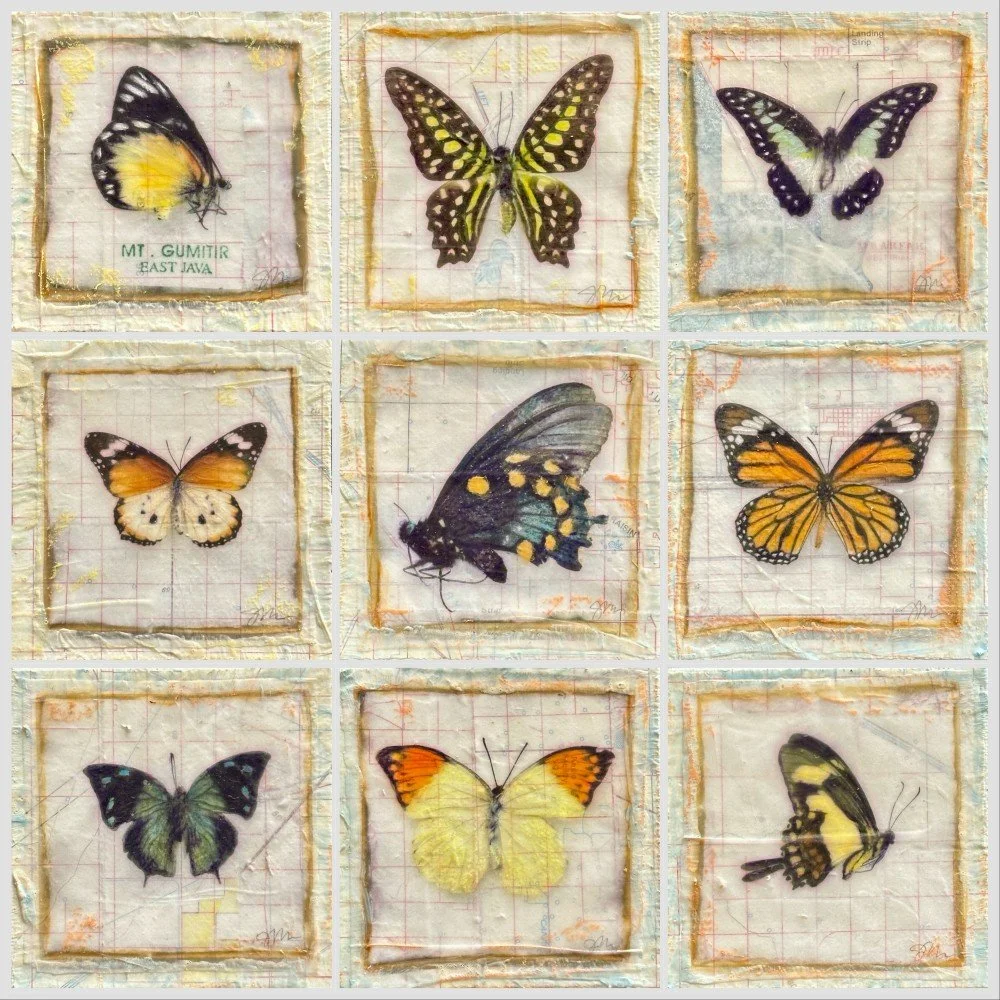
Butterflies provide endless inspiration for even my smallest artworks, like these Original Minis.
There are around twenty thousand butterfly species in the world, in an astonishing variety of patterns, colors, shapes, and sizes, almost anything you could imagine, and still recognizably be a butterfly. They are tiny, wild, beautiful creatures that flirt with us, tempt us with their closeness, and then move away. There is something about that quality - present and then gone - that has always captivated me.
But butterflies are not only beautiful. They undergo a transformation that is equally astonishing, and it is that transformation that appeals to me as much as their physical form. We generally learn as children that caterpillars form a chrysalis and emerge as butterflies, but the way it actually happens is something else entirely. For most of my life I assumed the caterpillar body slowly shifted and changed inside the chrysalis, gradually becoming what it would be. What I came to learn is far more remarkable: the caterpillar first completely liquefies. It becomes just liquid inside that tiny pouch and then reforms entirely into a butterfly. It is a kind of transformation that still makes my head spin.
This is why butterflies are such a powerful symbol for me in a spiritual sense, a representation of the kind of becoming that I believe is possible for all of us. Even when a butterfly is not the main subject of a piece, that underlying concept is always present. It is the heartbeat beneath the surface of the work.
As a child I had a butterfly net and the idea of a butterfly collection, though I don't think I ever actually managed to preserve any specimens. But that impulse toward systematic collection, identification, and the gathering of knowledge never left me. I now have a real and true butterfly collection, in a couple of ways. I collect specimens I find on my walks that are already at the end of their lifecycle, no net required. I also document living butterflies through photo observations on iNaturalist, which has become its own kind of collection and a way of contributing to the broader scientific record of what's living and thriving in my very local environment. I have also discovered that there are many reputable sources for exotic specimens online, and I make a point of ensuring that what I collect comes from farms where the protection and propagation of local butterfly populations is central to their mission. Many of these butterfly farms are formed specifically to preserve local species and habitat, with a shared commitment to protecting biodiversity, empowering rural communities, and fostering environmental awareness. Knowing that my collection supports those conservation efforts around the world matters to me.
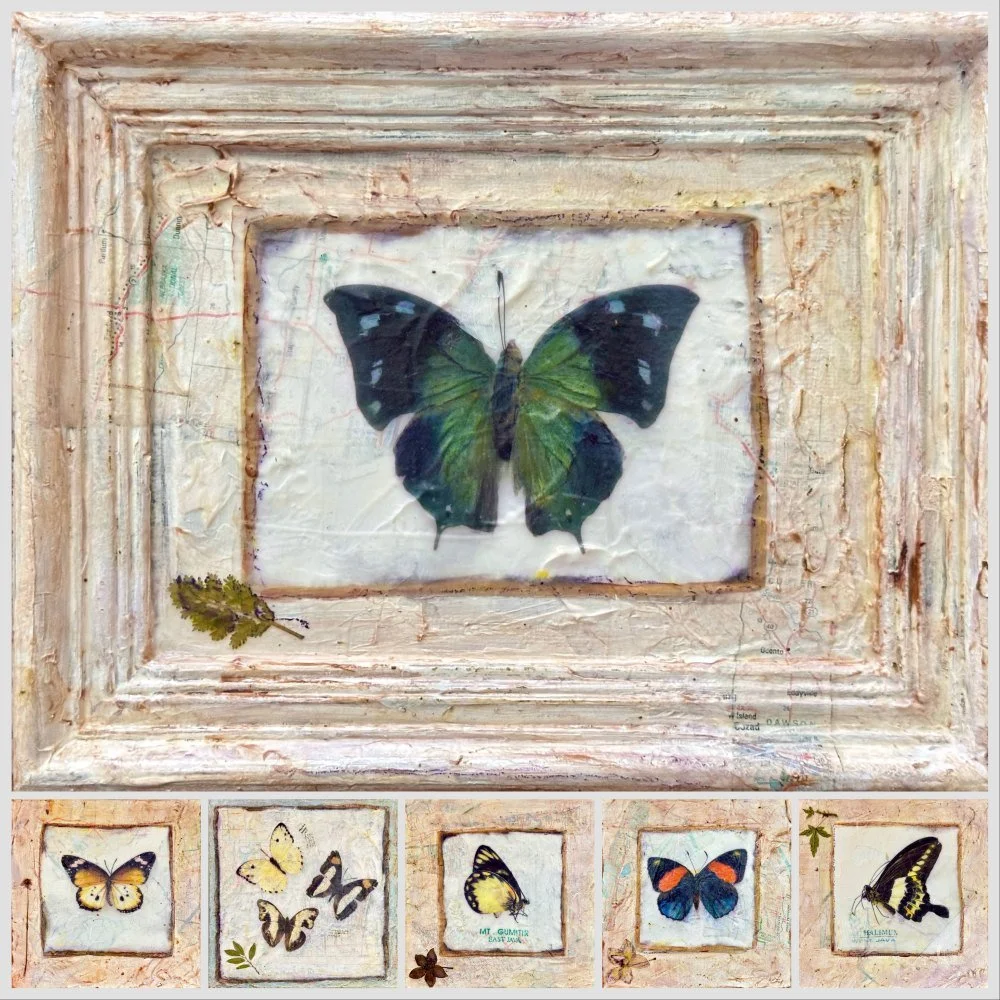
I’ve always envisioned a whole “Butterfly Collection” on a wall.
All of this - the observation, the study, the collecting, the reverence - feeds directly into my artwork, including my ongoing series simply called Butterfly Collection. I have always thought of this series as a way to collect and share butterflies without the concerns that come with physical specimens. Real specimens are fragile. They deteriorate. They are susceptible to damage and, inevitably, to the tiny creatures that would like to consume them. Artwork is more permanent, and it can be shared with more people.
So yes, I like butterflies. But what I'm really after is everything they carry with them: the transformation, the fragility, the impossible beauty of a creature that had to completely fall apart before it could become what it was always meant to be. That's the part that gets me every time.