Finding Hope in Decay
Why Dead Things Draw Me In
My artworks often portray specimens that are no longer alive, or as I usually call them, dead things. Even when I'm not photographing something dead, I almost always incorporate pressed dried leaves and flowers, roots, or feathers into the layers of a piece. There's just something about these earthy, finite things that draws me in and fascinates me.
"If you're new here and wondering why dead things show up in my work so often, you might want to start with this earlier post first, it lays the foundation for everything I'm about to say." How Dead Things Became My Love Language
I've come to realize that the beauty I see in them is not always apparent to other people and I think that's exactly why I share them. I want you to be able to appreciate the form and texture of a fallen bird, to see the delicate lines that connect a flower past its prime and a tiny jeweled beetle that no longer crawls around. Each of these things holds value, whether alive or not.
The Circle of Life in My Work
There is a larger narrative running through my work, exploring life and death, growth, decay, and renewal. When something dies, it never goes to waste. Plants and animals are consumed by other living organisms, or broken down by bacteria and fungi, returning nutrients to the soil that feed new plants, which feed new animals, which continue the cycle. We may mourn the loss of a single creature, but nothing is ever wasted. It is always part of the larger circle of life.
When the Wind Blows & When the Bough Breaks
Two pieces that illustrate these ideas are When the Wind Blows and When the Bough Breaks. I was working on them simultaneously, using bird's nests to hold objects not typically found in them, a baby doll and a jawbone, among other things that day. When I was creating the initial photographs, I wasn't consciously thinking about what I was communicating. I was simply in the flow of creation, putting together objects that felt right and recording them. Only later, as I was editing and then building up the physical layers of the pieces, did the themes begin to surface.
This is pretty typical of how I work.
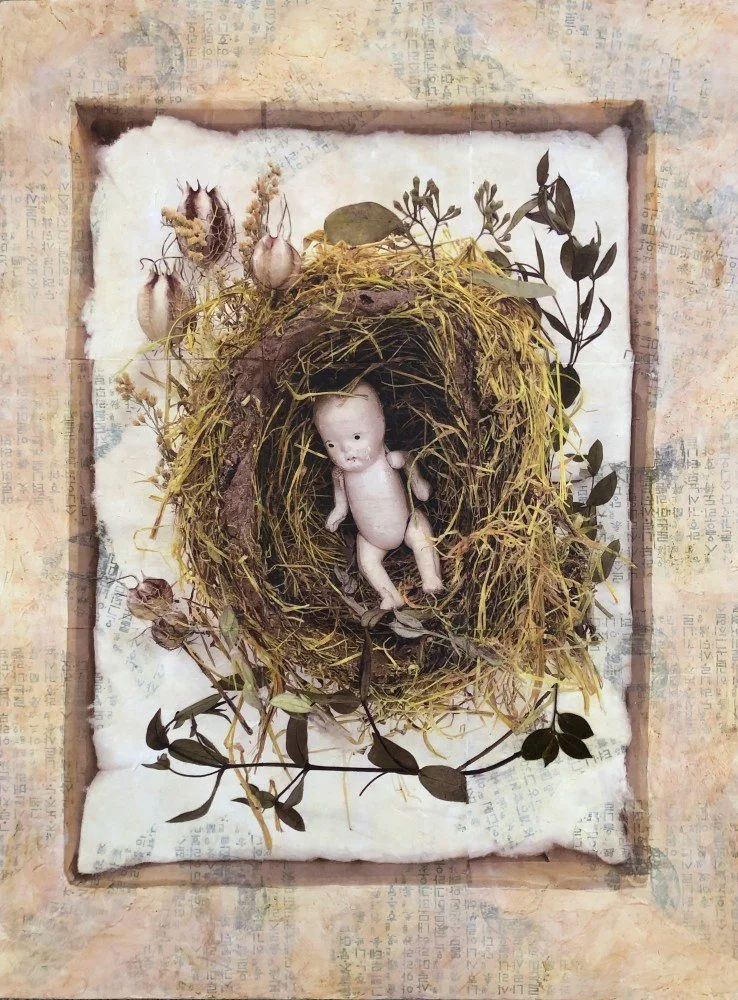
When the Wind Blows
The Objects & Their Stories
The nests in these images had all fallen from trees, been found by someone, and eventually made their way into my studio. The baby doll I purchased, something about its age and odd fragility attracted me to it. Human life, like all life, is so fragile, and the doll stands in for that fragility in a general sense. The jawbone was a treasure I found on one of my creek trail walks. Bones can be quite lovely if you can see the structure of them without being troubled by the death they imply.
A Nursery Rhyme Hidden in Plain Sight
It must have been the baby doll nestled in the nest that brought "Rock-a-Bye Baby" to mind. I had long been struck by the fairly grisly imagery buried in that familiar lullaby, and suddenly I saw the two stanzas illustrated in front of me. The first, “rock-a-bye baby, in the treetop, when the wind blows, the cradle will rock,” gentle, swaying, safe. And then, “when the bough breaks, the cradle will fall, and down will come baby, cradle and all,” a genuinely frightening image for anyone who has ever held a child. The jawbone felt like an apt illustration of that second stanza. And yet, just like the song itself, these pieces have a gentle beauty to them. Whether that makes sense to anyone else, I'm never entirely sure, but this is how my brain works.
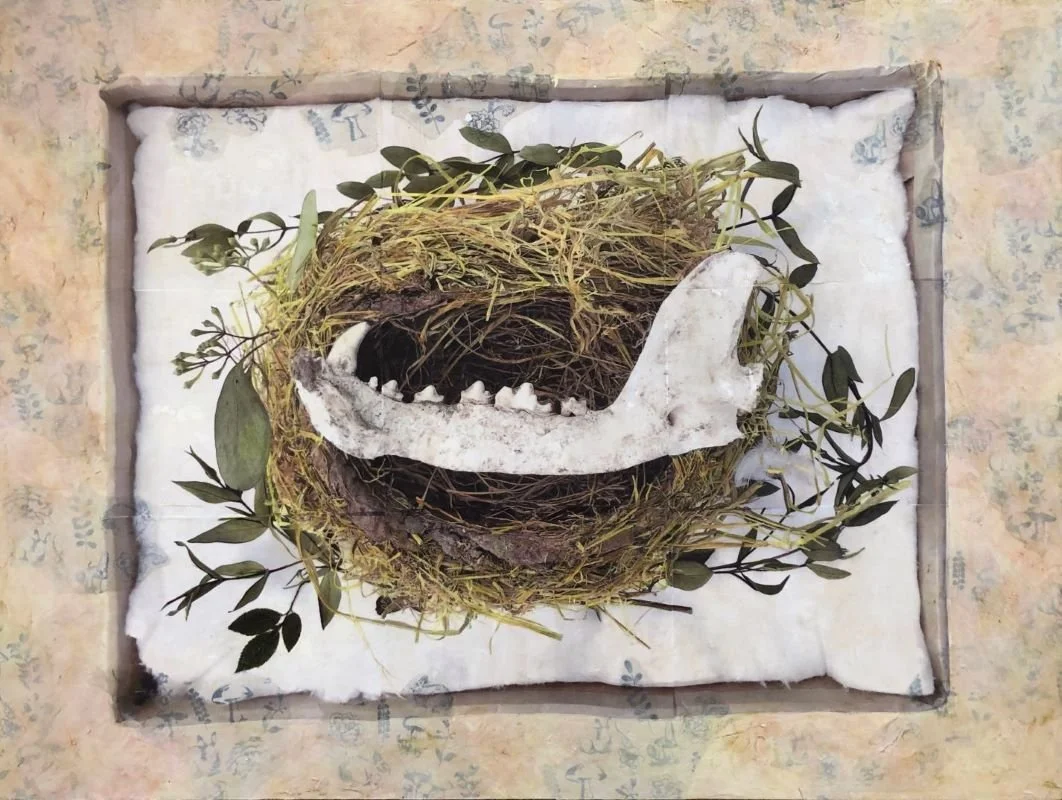
When the Bough Breaks
Where the Hope Comes In
It is all part of the hope and healing I am working through as I create. There are so many losses as we move through life, and if we can hold onto the larger picture - growth, decay, renewal, nothing wasted - it can make those losses a little easier to carry. I'm grateful to the people who have told me they get it. Otherwise, I might worry about myself.
Finding hope in decay is not a morbid pursuit. It is, I think, one of the most honest things I know how to do. The fallen bird, the jawbone, the nest that once held something precious and now holds something else; these are not sad endings. They are the whole story.
I don't always know what I'm saying when I'm in the middle of making something. It's only later, in the editing and the layering and the living with a piece, that the meaning surfaces. Maybe that's what hope is like too, not something you can grasp directly, but something that reveals itself slowly, in the details, if you're willing to keep looking.
Growth, decay, renewal. It's the only story there is, really. I just try to make it something beautiful to give us hope while we're in the middle of it.